
Europe’s New Packaging Rules Are Reshaping Global Brands Packaging Strategy - Why aseptic cartons and paper straws are gaining strategic importance
Europe’s rapidly evolving sustainability regulations are transforming packaging strategies across the global food and beverage industry. What was once largely a matter of corporate environmental commitments has now become a regulatory requirement with direct implications for market access.

Introduction
Europe’s rapidly evolving sustainability regulations are transforming packaging strategies across the global food and beverage industry. What was once largely a matter of corporate environmental commitments has now become a regulatory requirement with direct implications for market access.
For brands selling products in Europe, packaging is no longer simply a logistical or marketing decision. It has become a strategic compliance issue that affects product design, supply chains, and long-term competitiveness.
At the center of this regulatory shift is the EU Packaging and Packaging Waste Regulation (PPWR), adopted in 2024 and entering into force in 2025, with major requirements applying from 2026 onward. The regulation is part of the EU’s broader sustainability framework, including the European Green Deal and the Circular Economy Action Plan, which aim to significantly reduce resource consumption and transition industries toward climate neutrality.
The PPWR introduces several structural changes to packaging policy. By 2030, all packaging placed on the EU market must be recyclable or reusable. The regulation also sets packaging waste reduction targets of 5% by 2030, 10% by 2035, and 15% by 2040, compared with 2018 levels. In addition, stricter rules on packaging composition and the expansion of Extended Producer Responsibility (EPR) systems mean producers will increasingly be accountable for the lifecycle of packaging waste.
Alongside PPWR, the Single-Use Plastics Directive continues to restrict many disposable plastic products and encourage alternatives made from renewable or recyclable materials.
For global beverage and food brands exporting to Europe, these developments are forcing a fundamental reassessment of packaging formats. Increasingly, companies are turning toward solutions designed for recyclability, renewable material content, and reduced environmental impact.
One of the clearest outcomes of this policy direction is a shift away from complex plastic packaging structures toward fiber-based packaging materials such as paperboard cartons.
Fiber-based packaging aligns with several regulatory and market priorities:
Recyclability: Paper and carton packaging can be processed through established recycling systems across Europe.
Renewable materials: Paper fibers are typically sourced from responsibly managed forests.
Lower lifecycle emissions: Fiber-based materials often generate lower carbon footprints than many plastic alternatives.
Consumer acceptance: European consumers increasingly view paper packaging as environmentally responsible.
For beverage producers in particular, these trends are reinforcing the strategic relevance of carton packaging.
Aseptic Carton Packaging as a Strategic Packaging Format
Among the packaging technologies aligned with Europe’s regulatory direction, aseptic carton packaging has gained renewed strategic importance.
Aseptic packaging technology sterilizes both the product and the packaging before filling, enabling long shelf life without refrigeration or preservatives. The technology is widely used for milk, plant-based beverages, juices, and other liquid foods.
In addition to operational advantages, aseptic cartons offer several sustainability characteristics that align with emerging European regulatory priorities.
Renewable Material Structure
Aseptic cartons are primarily composed of paperboard derived from renewable wood fibers, reducing reliance on fossil-based packaging materials.
Logistics Efficiency
Carton packaging is lightweight and compact compared with many alternative packaging formats. This helps reduce transportation emissions and improve distribution efficiency.
Recycling Compatibility
Modern aseptic carton structures are increasingly designed to integrate with established recycling infrastructure, supporting the PPWR requirement that packaging must be recyclable by 2030.
Food Waste Reduction
Because aseptic cartons allow products to remain shelf-stable without refrigeration, they can help extend product shelf life and reduce food waste throughout the supply chain.
Together, these characteristics make aseptic cartons a packaging format that aligns both with regulatory compliance and supply-chain efficiency.
Replacing Plastic Accessories: The Role of Paper Straws
In addition to primary packaging, regulatory attention is also focused on single-use plastic accessories, including plastic drinking straws.
Under the EU’s Single-Use Plastics Directive, several commonly discarded plastic items are restricted or targeted for replacement due to their contribution to marine pollution. Plastic straws are among the most visible examples.
For beverage brands using single-serve packaging formats, replacing plastic accessories while maintaining product usability has become a practical design challenge.
Paper straws have emerged as a widely adopted alternative because they combine functionality with sustainability advantages:
Plastic-free material composition, reducing fossil-based resource use
Biodegradability under appropriate environmental conditions
Compatibility with recycling or composting systems
Positive environmental perception among consumers
For single-serve beverage cartons, paper straws provide a solution that supports both regulatory compliance and consumer expectations.
Packaging Innovation and Supplier Capabilities
As sustainability regulations reshape packaging requirements, beverage brands increasingly rely on material suppliers capable of developing packaging structures that combine environmental performance with technical reliability.
Within the aseptic packaging sector, innovation is increasingly focused on improving renewable content, simplifying material structures, and reducing lifecycle emissions while maintaining product protection.
Lamipak operates within this segment of the packaging industry, focusing on fiber-based aseptic carton materials and paper straw solutions, particularly within sleeve-fed packaging systems.
The company has developed several carton material structures intended to address different sustainability priorities.
LamiNatural, for example, incorporates unbleached brown paperboard, reducing chemical processing and providing a natural material appearance. The structure also integrates bio-based polymers intended to reduce reliance on fossil-derived plastics.
LamiPure explores aluminum-free carton structures. Removing the aluminum foil layer commonly used in aseptic cartons can simplify recycling processes and increase the share of renewable materials in the packaging composition.
LamiPristine focuses on optimizing carton material structures and production processes to reduce carbon emissions while maintaining the barrier properties required for shelf-stable beverages.
These developments reflect broader industry efforts to improve the environmental performance of aseptic packaging through material redesign and lifecycle optimization.
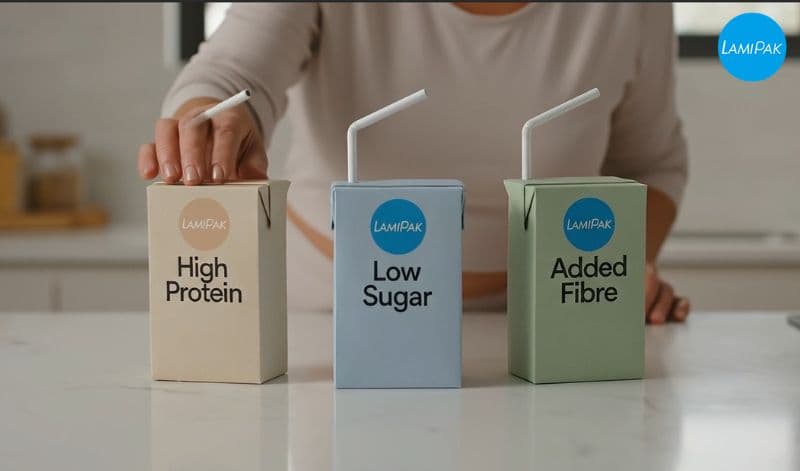
Alongside carton materials, Lamipak also produces paper straws designed for compatibility with beverage carton packaging formats, addressing regulatory pressure to replace plastic accessories in single-serve beverage products.
Strategic Implications for Beverage Brands
For global beverage manufacturers selling products in Europe, sustainability regulations are transforming packaging decisions into long-term strategic considerations.
Future compliance with frameworks such as the PPWR will increasingly depend on packaging solutions that combine recyclability, renewable materials, and efficient resource use.
Aseptic carton packaging and paper-based accessories represent one pathway for achieving these objectives, particularly within the liquid food and beverage sector. At the same time, the transition toward sustainable packaging will require close collaboration between brands, packaging suppliers, and technology providers.
Companies that begin adapting their packaging strategies now will be better positioned to navigate Europe’s evolving regulatory environment while strengthening their sustainability credentials in a market where environmental performance is becoming a central competitive factor.