

Plant-Based Milk in Southeast Asia: Thailand Leads a Regional Shift Toward Health, Sustainability, and Product Diversification
The plant-based milk category across Southeast Asia is undergoing a significant transformation. What began as a primarily soy-driven market is now expanding into a diverse and innovation-led segment, shaped by evolving consumer priorities related to health, sustainability, and lifestyle. While each Southeast Asian market is at a different stage of maturity, the direction of change is consistent: consumers are increasingly open to dairy alternatives, and the assortment of plant-based products is widening as brands compete to capture new value pools.
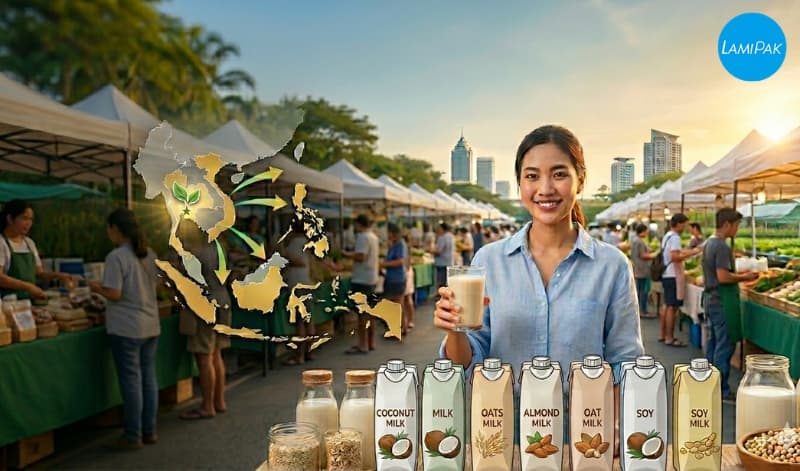
The plant-based milk category across Southeast Asia is undergoing a significant transformation. What began as a primarily soy-driven market is now expanding into a diverse and innovation-led segment, shaped by evolving consumer priorities related to health, sustainability, and lifestyle. While each Southeast Asian market is at a different stage of maturity, the direction of change is consistent: consumers are increasingly open to dairy alternatives, and the assortment of plant-based products is widening as brands compete to capture new value pools.
Among the region, Thailand stands out as a mature and influential market, not only due to its established consumption base but also because it is shaping how plant-based dairy is positioned, fortified, and premiumized across the region. Meanwhile, Vietnam and Indonesia are emerging as fast-growing markets with rising penetration, signaling strong opportunity for early movers.
Regional Landscape: Growth Potential Across SEA-5
Market volume and growth rates across SEA-5 (Thailand, Vietnam, Indonesia, Malaysia, and the Philippines) show varied maturity and expansion trajectories:
From this landscape, three strategic insights emerge:
- Thailand provides a model for scale and category breadth, with high availability in both modern and traditional retail.
- Vietnam is entering a premium diversification phase, where consumers increasingly evaluate products based on ingredient quality, functional benefits, and brand storytelling.
- Indonesia is the fastest-growing expansion market, where education, affordability, and distribution access will define competitive success.
Across all markets, health awareness, clean-label expectations, and sustainability narratives are gaining relevance in driving adoption.

Thailand: The Benchmark Market in SEA’s Plant-Based Dairy Landscape
Thailand has one of the highest plant-based milk consumption levels in Southeast Asia, shaped by:
- A long cultural familiarity with soy beverages,
- A high prevalence of lactose sensitivity, and
- The strong availability of affordable UHT formats across convenience retail.
While soy remains the dominant segment, the dynamics within the category are shifting. From 2018 to 2024, Thailand’s plant-based milk market has transitioned from being overwhelmingly soy-centric to embracing a growing portfolio of non-soy dairy alternatives such as almond, oat, coconut, pistachio, rice, and sesame-based milks.
Soy Continues to Lead—But Growth Is Now Driven Beyond Soy
- Soymilk currently accounts for the majority of category volume, supported by affordability and widespread availability.
- However, growth rates differ:
- Soymilk projected CAGR (2024–2028): ~2%
- Other plant-based milks projected CAGR (2024–2028): ~7%
This signals a mix shift toward premium and functional offerings, largely influenced by younger consumers, café culture, and lifestyle branding.
Consumption Drivers: Health, Wellness, and Functional Benefits
Thai consumers’ move toward plant-based milk is rooted in wellness-driven decision-making. Surveys reveal that 59% of Thai consumers cite health as the primary driver when choosing plant-based milk. The most influential product claims found in new product launches include:
- No additives or preservatives
- High or good source of protein
- Lactose-free and gluten-free
- Low or reduced cholesterol
- High fiber or added vitamins and minerals
In addition, functional positioning is becoming increasingly differentiated, with brands introducing:
- Collagen-enhanced variants targeting beauty-conscious consumers,
- Omega-3, GABA, or ginseng-fortified formulations for brain and cardiovascular health,
- High-protein or fiber blends, supporting active lifestyle and meal-replacement occasions.
This multi-benefit narrative allows plant-based milk to command premium price segments, especially in convenience stores, cafés, and e-commerce channels.
Innovation Beyond Soy: Flavor, Texture, and Café Culture as Catalysts
New product development data from Thailand shows that 58% of recent launches are non-soy plant-based milks, with the fastest-growing segments being:
- Almond milk (26%)
- Oat milk (22%)
- Coconut milk (18%)
These variants are winning for three reasons:
- Texture superiority in coffee applications (especially oat milk),
- Lifestyle alignment through low-sugar and clean-label messaging,
- Modern flavor and packaging cues, supporting premium positioning.
The rise of barista-style plant-based milks in Thailand’s café and specialty coffee scene is accelerating everyday familiarity and repeating purchase behavior.
SEA Outlook: Thailand as the Trend Setter
Thailand’s plant-based milk market acts as a category blueprint for the region:
- Vietnam is adopting Thailand’s model of premium soy + expanding non-soy alternatives, led by young urban consumers in Hanoi and Ho Chi Minh City.
- Indonesia is beginning to mirror Thailand’s early phase, where affordability and education will be vital in shaping the next wave of adoption.
- Regional supply chain and packaging innovation originating in Thailand is increasingly influencing product stability, shelf-life optimization, and sustainability claims across SEA.
Conclusion: The Next Chapter of Growth in SEA Plant-Based Dairy
The future of plant-based milk in Southeast Asia will not be defined by soy alone. Soy ensures accessibility and volume scale—but the next growth horizon is anchored in choice, benefits, and experience.
Thailand will continue to guide this movement, setting trends in:
- Functional formulation
- Premium and lifestyle branding
- Café partnerships and usage expansion
- Sustainable and clean-label claims
As Vietnam and Indonesia accelerate in penetration and diversification, the regional market is poised to shift from niche adoption to mainstream multi-segment growth.
This is not merely a category expansion—it is the evolution of how Southeast Asian consumers define healthy, modern, and conscious nutrition.